
WKRM Fall '23
Overview
Clients:
-Austin Transit Partnership
-UT Office of Campus Operations
Tools:
-Figma
-Blender
-Adobe Illustrator
-Adobe Photoshop
-Physical Prototypes
Timeline:
-12 Weeks
-Fall '23
Team:
-WKRM '23 Cohort
-Professor Jon French
Summary
Our team was tasked with researching and synthesizing information about the mindset and experiences of UT Austin students in relation to mobility on and around the UT Campus.
At the end of the semester we were given the opportunity to present our findings, as well as speculative designs for problems we identified, to the Austin Transit Partnership and Gehl.
Key Takeaways
-
Gained valuable experience working and communicating with real world clients
-
Learned to work with a team and leverage each members individual strengths to successfully complete our project.
-
Learned about myself and my own personal strengths and passions in the design field.


DELIVERABLES




READ MORE
BACKGROUND
Who is this project for?
Project Connect is an initiative aimed at creating a light rail network to service the denizens of the city of Austin, Texas.
Project connect works directly with the Austin Transit Partnership and the government of the city of Austin. They seek to gain a better understanding of the student mobility experience and what the student culture around mobility and transit is at the University of Texas at Austin (UT).
This is all in preparation for the introduction of a light rail line which will run directly down Guadalupe Street. This street separates the UT campus from an area called West Campus which is where the majority of UT students live. This area is the most densely populated area in the entire state of Texas.

A render of the light rail from the Austin Transit Partnership's website
What exactly are we doing?
Our class was lucky enough to be given the opportunity to work directly with the Executive Vice President of the Austin Transit Partnership, Peter Mullen, as well as the Associate President of Campus Planning at UT, Brent Stringfellow. We also met directly with Paulo Faria, who has 25 years of experience working in transportation architecture.
We were tasked with researching and documenting the current transit experience for University of Texas at Austin students. Through frequent discourse with our clients about our findings we were able to conceptualize tools and ideas for our clients to use in order to inform their future designs.

RESEARCH
How do we wrap our heads
around student mobility?
Initially our clients provided us with five areas to base our research around. These areas were:
-Transit & Mobility Culture
-Transit Literacy
-Campus Disruptions
-Mobility Apprehension
-Light Rail Integration
In order to understand these categories more we used a variety of different research methods. These included surveys, interviews, ride-alongs, internet research, and field observations among other things in order to give us a more complete understanding of the current state of each of the five research areas.
We synthesized our research findings in to one page overviews (One-Pagers) that quickly summarized all of our key findings. Read our One-Pagers on the WKRM website.


How do we use this data?
We wanted to create a frame work from the information we synthesized together as a group. This would allow our client to view the core essence of what we learned at a glance and apply it to whatever they may be working on.
As a group we worked through many different iterations in order to find a framework that we felt would best represent our findings. We spoke directly with our clients during this process in order to create something that would be as useful as possible for them.
Eventually we decided on a cyclical framework that can feed into itself from the outside to the inside or vice versa. The framework is meant to show each of the different factors that play into the student mobility experience. Each of these factors feed into one another and often facilitate one another.
Our group took this framework and applied it to our rider type models. These rider types provide a snapshot view of the different ways students navigate campus. By applying our framework we were able to demonstrate which needs different rider types have.
You can view all of the Rider Type Frameworks as well as our other findings on the WKRM Website.

CONCEPTS
Applying our framework into speculative designs.
Over the course of our semester our group members came up with countless ideas for speculative designs. These designs tackled a variety of different problems and employed multiple different tools and programs to conceptualize them. We attempted to find a holistic solution to the many challenges students face in their daily transit journeys.
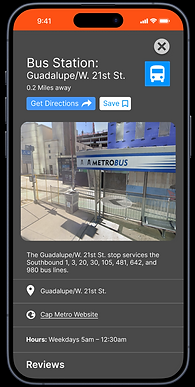
Mobility Matters App
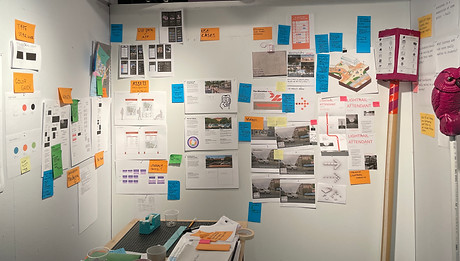
The Mobility Matters app was our attempt at fixing many of the issues we encountered with existing wayfinding applications. We gained many insights about why some students found these applications difficult to use through our Ride-Along research. On these Ride-Alongs my teammates and myself shadowed people as they tried to reach a grocery store near campus. Through our experiences with these Ride-Along volunteers we were able to develop the Mobility Matters App.

Improvements
The main improvements we made include
but are not limited to:
-Bus icons that live update every few seconds to where that bus is currently.
-Information about specific bus stops, such as what bus lines stop there. and whether it is a southbound or northbound stop.
-Information about bus lines such as what times they run at. We also found that including pictures of the buses was important.
-Pedestrian hazard alerts that could be added and updated by the community. This way hazard alerts will be relevant and timely.
-Denoting important landmarks on the map.
-Using unique icons for different types of public transit (buses, bikes, scooters, etc).
-More options for what is or is not displayed on the map.

Mobility Markers
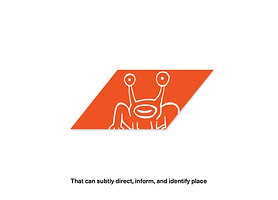
Mobility Markers are our idea for creating physical wayfinding affordances that can passively help students understand and navigate their environment more effectively.
These concepts allowed us to show our clients how we imagine they could integrate signage into the environment in order to enhance the mobility experience of students on and around the UT campus.
Our group resonated with using a rhombus for the shape of our mobility markers because it is a distinct shape that no other common signage has. We also felt that this shape envoked the feeling of moving forward.

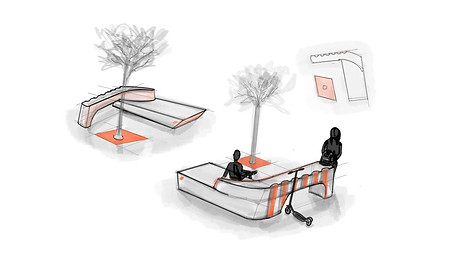
Mobility Waystations
Mobility Waystations aim to be an oasis for pedestrians to rest, orient themselves, get relevant information, and move on. We wanted to find a way to retrofit existing spaces within the urban environment to make them more pedestrian friendly. This would mean adding amenities and supporting existing modes of transit.

Street Views
During discussions wih our clients about the chaos of navigating high density intersections such as the intersection Guadalupe St and 23rd st, we learned that they had never actually had the chance to try and navigate the UT campus or its surrounding area themselves.
This spurred the idea of recording “Street Views.” Street Views are short videos of different areas on and around campus meant to allow our clients to experience being a mobile student at UT. We also recorded views from various rider type points of views such as that of the Scooter Rider and Bicyclist among others.

Transit Wiki
In our research we found that many students lack Transit Literacy. That is to say they lack an understanding of transit options and systems within the city of Austin. This lack of transit literacy affects students in two major ways. Students are unsure of both the transit options and how to navigate using these options. This interactive wiki aims to solve both issues.
Users take a quiz which determines the best transit options for that individual user. The user is then able to learn more information about these options through the Wiki.

Sarcastic Map
Poking fun at the social map of the area around UT Austin. This “Sarcastic Map” presents an authentic depiction of the varied student experience within and around the University of Texas. The map serves as a narrative that not only highlights the student's perspective through lived experiences but also infuses it with clever and insightful commentary.
The Sarcastic Map is meant to bee a way for our clients to glean an understanding of the culture of UT students at glance. We hope that by understanding how students think they can have more success designing for students

Light Rail Attendant Brochure
Due to many students lack of understanding about how to use common public transit systems, such as the bus, we felt that it would be valuable to have a sort of attendant for people wanting to use the light rail. Similar to how a concierge works, we thought that there could be a service role which informs and assists people in learning how to use light rail services.
As an extension of this idea members from our group created a speculative brochure that may be given out to light rail attendants as part of their training.

Mobility Modes Cards
The “Mobility Modes Cards” are meant to be a bite-sized and more appealing way for UT students to learn about their transit options. These cards could work especially well for new students who are often completely in the dark about what the possibilities for getting around are.

REFLECTION
Sharing student perspectives on mobility and the future integration of the light rail at UT.
Our main goal with this project was to provide our clients with the student perspective on transit and mobility. Our WKRM team is by no means experts in architecture or engineering or anything that would typically be related to planning such a large civic project. However we are experts on what it is like to be students at The University of Texas at Austin.
Through our research we were able to help our clients gain a deeper understanding of how UT students perceive and navigate the world around them. We think this information can be invaluable to the Austin Transit Partnership team as they work to curate a light rail stop that will service one of their largest potential rider demographics, UT students.
Our hope is that our work here in WKRM will facilitate a new culture of transit within the city of Austin and will prompt students to welcome new public transit projects such as the light rail with open arms and open minds.

